

Menu
Dentistry · Dental Implants
Dental Implants in Antalya, Turkey
A dental implant replaces a missing tooth root and can support a crown, a bridge or a full-arch restoration. Implant treatment should be individually planned around your oral health, available bone, medical history and restorative requirements — this is the honest, in-depth guide to how that planning works.
Request a Dental Implant AssessmentFree consultation · coordinated clinical review · clear written plan
What is a dental implant?
A dental implant has three conceptual parts: the implant fixture — a small titanium post placed in the jawbone that acts as an artificial tooth root; the abutment — the connection piece; and the restoration on top — a crown for a single tooth, a bridge for several, or a full-arch prosthesis. The fixture integrates with your bone over time, which is what gives a well-planned implant its stability.
What does the starting implant price include?
Our listed implant fees include the abutment; the zirconia implant crown is priced separately. For example, a Medigma BioMedical MARS implant (£415 including abutment) plus a zirconia implant crown (£180) adds up to £595. A Straumann Neodent implant (£500 including abutment) plus the same crown adds up to £680. These are component-price examples in GBP, not complete treatment quotations. Your written plan confirms any additional procedures, visits, travel arrangements and the final total.
See current implant prices and package scope
Comparing full-arch treatment? Read our All-on-4 and All-on-6 guide for the advertised both-jaw package scope, then ask for an itemised quotation for your own plan.
Comparing a UK quotation? Compare the complete treatment and trip cost using matching components, visits and exclusions.
Types of implant treatment
- Single dental implant — one missing tooth, restored with an implant crown; neighbouring teeth stay untouched.
- Multiple dental implants — several missing teeth, each restored or grouped as the plan requires.
- Implant-supported bridge — a span of missing teeth carried on fewer implants than teeth replaced.
- All-on-4 / All-on-6 — full-arch restoration on four or six implants; see the dedicated All-on-4 & All-on-6 guide.
- Full-arch implant rehabilitation — individually designed replacement of a complete arch.
Who may be considered for implants?
Implants may be considered for
- One missing tooth, multiple missing teeth, or a complete missing arch
- Teeth that cannot predictably be restored, after honest assessment
- Denture wearers who want fixed teeth, where anatomy allows
What suitability depends on
- Oral health, gum condition and oral hygiene
- Bone quantity, bone quality and anatomy
- Medical history, medications and smoking
- Your bite and the restorative plan for the final teeth
One principle we hold firmly: natural teeth should not be extracted simply to make implant treatment possible when they can predictably be preserved. If a tooth can be saved — for example with root canal treatment — that option is discussed before any extraction plan is agreed.
Implant brands — and why traceability matters more than logos
Implant systems referenced through our Antalya partner pathway include Straumann, Global D and Medigma BioMedical MARS. No brand is universally best; the treating dentist selects the system according to the case. Ask for written records identifying the manufacturer, implant system or model and components used, together with any applicable treatment or manufacturer warranty terms. Clear traceability helps future dentists identify the system if maintenance or replacement components are ever needed.
Before leaving, use our implant records checklist to ask for the details of the system and components used.
Consultation, imaging and bone assessment
Implant planning draws on your medical and dental history, clinical examination, a panoramic X-ray and CBCT (3D) imaging where clinically required — plus restorative planning, because the implant exists to serve the final tooth, not the other way round. Implant position and stability depend partly on bone quantity, bone quality and anatomy, which is exactly what the imaging shows. You can send an existing X-ray before you travel; final planning is confirmed after clinical examination.
Bone grafting and sinus lift
Where bone is insufficient, bone grafting may be considered to rebuild volume — and in selected upper-jaw cases, a sinus lift creates the additional bone height implants need near the sinus. Neither is a default: your imaging decides, and if grafting is recommended you’ll understand why before you agree to anything.
If grafting is proposed, use our bone graft and sinus-lift planning guide to prepare questions about stages and travel.
Placement, healing and your new teeth
- 1 · Implant placement — the fixture is placed in the jaw under anaesthesia; the surgical visit typically needs 3–4 nights in Antalya.
- 2 · Healing and osseointegration — bone integrates around the implant. Timelines vary by patient and case; no universal healing time is promised, and your clinician confirms yours.
- 3 · Temporary teeth where appropriate — depending on implant stability, your bite, the treatment design and clinician judgement.
- 4 · Final crown or bridge — after the required healing period, the definitive restoration is made, tried and fitted.
How many trips this means — one or two, and the gap between them — depends on your treatment pathway and is confirmed in your written plan before you book flights.
Plan your implant visits and treatment stages
Risks — stated plainly
Implant treatment is well established, and it still carries risks: infection, failure of an implant to integrate, gum and peri-implant disease, nerve-related complications depending on location, sinus-related complications in selected upper-jaw cases, and mechanical or prosthetic complications over the years. Smoking and poor oral hygiene raise the risks significantly. The treating clinician explains the risks relevant to your case and how they are managed — before you decide, not after.
Implant aftercare
Implants need what natural teeth need, done consistently: daily cleaning (including around implant restorations), professional reviews, healthy gums and honest attention to smoking. Written aftercare guidance and medications are included, our patient line stays reachable 24/7 after you fly home, and we coordinate with the clinic on any clinical question during healing and beyond.
Implant warning signs and next steps
Read about implant warning signs and next steps, including the difference between an implant problem and a restoration problem.
Common questions
Are dental implants safe — and do they hurt?
Implant placement is a well-established procedure carried out under anaesthesia, so you should not feel pain during surgery; swelling and tenderness for a few days afterwards is normal. Safety depends on proper planning, imaging and sterile technique — which is why we insist on all three.
How long do implants take to heal?
Bone integration takes time and varies by patient, jaw and case — the honest answer is a range confirmed by your clinician, not a universal number. Beware of anyone promising identical healing for everyone.
Can implants be placed immediately after extraction?
Sometimes — immediate placement is possible in selected cases, depending on infection, bone and stability. In others, the socket needs to heal first. Your imaging and examination decide, and the sequencing is set out in your written plan.
Will I need bone grafting?
Only if your imaging shows there genuinely isn’t enough bone to place the implant securely. A CBCT scan answers this properly — it is a clinical decision from your anatomy, never a default add-on.
Which implant brand should I choose?
No brand is universally best. Suitability matters more than the logo. Ask for records showing the manufacturer, implant system or model and components used, together with any applicable warranty terms, so future clinicians can identify the system accurately.
How long can implants last?
With good hygiene, regular reviews and a healthy mouth, implants can serve for many years, but longevity varies and no fixed lifespan can be promised. Warranty duration is separate from clinical lifespan; ask for the written terms that apply to your treatment and implant system.
Can smokers have dental implants?
Often yes — but smoking measurably raises the risk of implant failure and gum problems, so it is weighed honestly in your assessment, with clear guidance on reducing risk around surgery and healing.
How many trips to Türkiye might be required?
Many implant pathways involve a surgical visit and a later restorative visit; some cases allow fewer. Your written plan confirms the number of trips and the days for each before you book anything.
Find out what’s actually possible for your jaw
Send your dental X-ray or existing scans to New Look Smile Group. Our team coordinates an initial review and, where needed, a discussion with a treating dentist so you can understand the options, likely stages and next steps before deciding.
Send Your Dental X-RayView individual implant, abutment and crown prices
Compare dental package options →

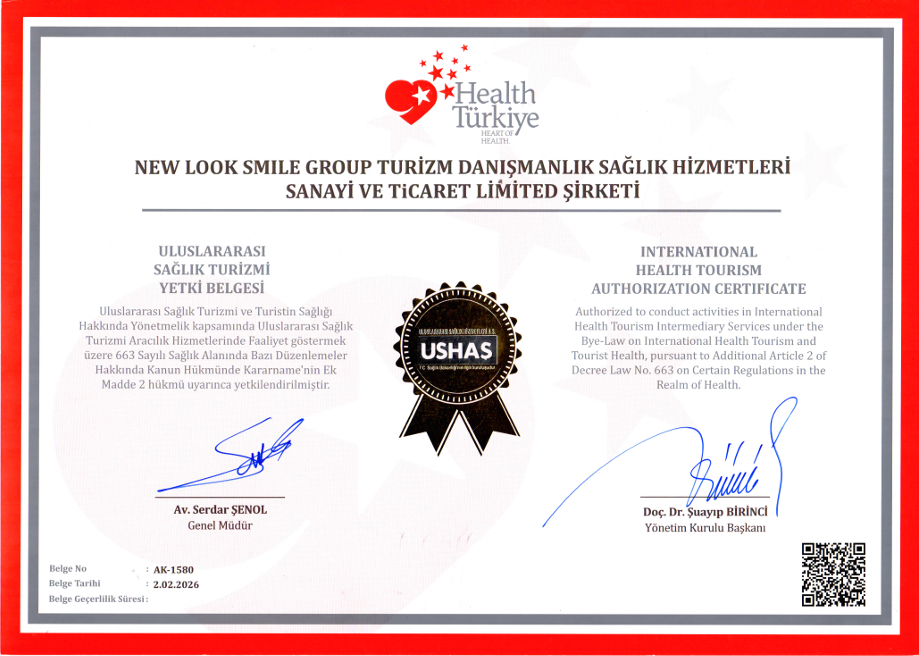
Ministry of Health Authorized — International Health Tourism Authorization, Certificate AK-1580. Click the certificate to view it in full.