

Menu
Dentistry · All-on-4 & All-on-6
All-on-4 & All-on-6 Dental Implants in Antalya, Turkey
Full-arch implant treatment may be considered where most or all teeth in a jaw are missing, or cannot predictably be restored. A transparent guide to how All-on-4 and All-on-6 work, how the choice between them is made — and why neither is automatically “better”.
Request a Full-Arch Implant AssessmentFree consultation · coordinated clinical review · clear written plan
What are full-arch dental implants?
Full-arch implant treatment replaces a complete row of missing or severely compromised teeth using several dental implants to support a fixed or removable prosthetic restoration. Instead of one implant per missing tooth, a small number of strategically positioned implants carry a full arch of replacement teeth.
What do All-on-4 and All-on-6 mean?
All-on-4 uses four implants to support a full-arch restoration in selected cases, often with the back implants angled to make best use of available bone. All-on-6 uses six implants in selected cases, spreading the load across more fixtures. Implant number, implant position, loading protocol and prosthetic design are individually planned — the name of the concept matters far less than the plan behind it.
Who may be considered — and what suitability depends on
Full-arch treatment may be considered for
- A complete arch of missing teeth
- Severely compromised dentition that cannot predictably be restored
- Unstable or poorly tolerated removable dentures
- Multiple failing teeth where tooth-by-tooth repair is no longer realistic
Suitability depends on
- Bone quantity and quality, gum health and anatomy
- Medical history and current medications
- Smoking, oral hygiene and your bite
- The prosthetic plan — the teeth you end up with, not just the implants
One honest line matters here: natural teeth should not be extracted simply to make implant treatment possible when they can predictably be preserved. If some of your teeth can be saved, that option is discussed openly before any full-arch plan is agreed.
All-on-4 vs All-on-6 — how the choice is made
The decision weighs the number of implants against your bone availability, anatomy, prosthetic design, load distribution, treatment complexity and long-term maintenance. More implants is not automatically better — six implants in poor bone is not superior to four well-placed ones, and vice versa. The treating clinician makes the recommendation from your imaging and examination, and explains the reasoning so you understand why your plan looks the way it does.
Diagnostic planning
Full-arch planning starts with clinical examination and a panoramic X-ray, with CBCT (3D) imaging where indicated — it shows bone height, width and quality, and the position of nerves and sinuses. Just as important is prosthetic planning: the final teeth are designed first, and the implants are positioned to support that result. You can send an existing X-ray before you travel; final planning is confirmed after clinical assessment.
Treatment stages
- 1 · Preliminary assessment — photos, X-rays and your medical history, reviewed before you book.
- 2 · Clinical examination and imaging — in Antalya, with CBCT where indicated.
- 3 · Treatment planning — implant positions and the prosthetic design, agreed with you.
- 4 · Extractions where clinically required — only teeth that genuinely cannot be saved.
- 5 · Implant placement — the surgical stage, typically needing 3–4 nights in Antalya.
- 6 · Temporary restoration where clinically appropriate — depending on implant stability and your case.
- 7 · Healing / osseointegration — bone integrates around the implants; no honest clinic promises a universal timeline.
- 8 · Final prosthetic stage — the definitive bridge is made, tried and fitted.
- 9 · Maintenance — cleaning, reviews and long-term care.
How many trips this means for you — and the gap between stages — is confirmed in your written plan before you book flights, so there are no surprises.
Understand surgical and restorative visits
Temporary vs final teeth
A provisional (temporary) restoration may be fitted while your implants integrate, where implant stability, your bite, the treatment design and the clinician’s judgement allow. The final restoration is a separate, definitive piece of work — stronger materials, refined fit and appearance. Whether a temporary is fixed or removable in your case is part of the plan, not an assumption.
What do our advertised both-jaw packages include?
Our advertised All-on-4 package starts from £8,000 for both jaws, with eight implants and abutments. All-on-6 starts from £9,000 for both jaws, with 12 implants and abutments. Both packages are planned across two visits and list final restorations comprising 24 zirconia crowns on two titanium bars. These are starting package prices in GBP, not per-jaw or implant-only fees. Your treating dentist confirms suitability and the clinical plan, and your written quotation confirms the final scope and total.
Compare one jaw with one jaw, and both jaws with both jaws. Check whether each quote covers implant placement, temporary teeth, the final restoration and every planned visit. Match those inclusions before comparing a per-implant, per-jaw or both-jaw advertised price.
See the dental prices and packages page for the listed accommodation, temporary teeth, allowances, transfers and exclusions. Your written quotation confirms what is planned and payable on each visit.
Bone grafting and sinus procedures
Some patients need additional bone procedures — bone grafting or a sinus lift — depending on anatomy. Angled-implant concepts like All-on-4 can reduce the need for grafting in selected cases, but they do not always avoid it, and no honest assessment promises otherwise. Your imaging decides.
Implant systems and traceability
Implant systems referenced through our Antalya partner pathway include Straumann, Global D and Medigma BioMedical MARS. No brand is universally best; the treating dentist selects the system according to the clinical and restorative plan. Ask for written records identifying the implant system and components used, together with any applicable warranty terms, so the system remains traceable for future maintenance.
Cleaning, risks and long-term maintenance
A full-arch restoration needs daily cleaning — including beneath the prosthesis — plus professional maintenance and monitoring of the gums and implants. Risks include infection, failure of an implant to integrate, peri-implant disease, prosthetic wear and mechanical complications; repairs and maintenance over the years are normal, not a sign of failure. Smoking and poor hygiene raise the risks significantly — the treating clinician is honest about this before treatment, and our team stays reachable 24/7 after you fly home.
Check aftercare and component cover
Keep your implant and restoration details with your follow-up plan; our implant records checklist explains what to request.
Common questions
What is the difference between All-on-4 and All-on-6?
All-on-4 uses four implants to support a full-arch restoration; All-on-6 uses six. The more appropriate option is not determined by the number alone — bone volume, anatomy, implant positions, bite and the restorative plan all influence the treating dentist’s recommendation.
How does the dentist decide between four and six implants?
From your imaging and examination — bone quantity and quality, anatomy, bite and the design of your final teeth. The recommendation is explained to you with its reasoning, not handed down as a package name.
Will I have temporary teeth?
Where implant stability and your case allow, a provisional restoration may be fitted while the implants integrate. Whether that is fixed or removable for you is confirmed in your plan — same-day fixed teeth are not promised to everyone, because they are not right for everyone.
How long does implant healing take?
Bone needs time to integrate around implants, and the honest answer is that it varies — by patient, jaw and case. Your clinician confirms the expected timeline for you; universal healing promises are a warning sign, not a reassurance.
Can smokers have full-arch implants?
Smoking raises the risk of implant failure and gum problems, so it is weighed honestly in your assessment. Many smokers can still be treated — with clear guidance on reducing risk around surgery and healing — but you deserve the real numbers conversation, not a brush-off.
What happens if there is not enough bone?
Options may include bone grafting, a sinus lift, or implant positions and angles that make better use of available bone. Your clinician uses imaging and clinical assessment to determine what is appropriate for your case.
How many trips to Türkiye might be required?
The advertised both-jaw All-on-4 and All-on-6 packages are planned across two visits. Your written plan confirms the work and days needed for each visit, and the treating team confirms the interval between stages, before you book flights.
Find out what your jaw actually needs
Send your X-ray or a few photos. New Look Smile Group coordinates the initial review and clinical discussion so you can understand whether full-arch treatment may be suitable, how All-on-4 differs from All-on-6, and what diagnostic steps come next.
Request a Full-Arch Implant AssessmentView individual implant and titanium-bar prices
Compare dental package options →

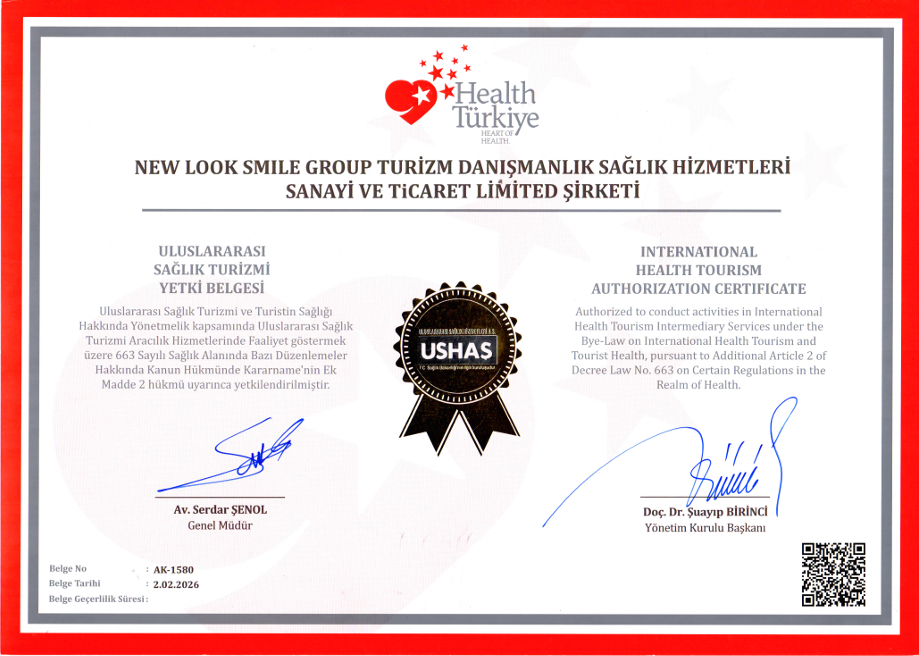
Ministry of Health Authorized — International Health Tourism Authorization, Certificate AK-1580. Click the certificate to view it in full.